Guides
What Is a Video Intelligence API? Enterprise Buyer Guide
A video intelligence API indexes recorded video for search by scenes, speech and text. Learn what it does, how pricing works, and how it differs from a VMS.

TL;DR
A video intelligence API is a hosted interface that ingests recorded video, builds a searchable index of scenes, speech and on-screen text, and returns ranked moments to your apps. Buyers should compare indexing depth, query pricing, retention rules and deployment options—not label lists alone.
What is a video intelligence API? It is a hosted programmatic interface that accepts recorded video, builds a searchable index of what appears, what is said, and what is shown on screen, and returns ranked moments or structured analysis to your applications over HTTPS. Buyers evaluating “video intelligence api” in Search Console or RFP text are usually comparing investigation backlogs, not shopping for another NVR login. This guide answers that buyer question directly: capabilities, pricing shapes, vendor traps, and how the pattern differs from a VMS.
What problem does a video intelligence API solve?
Security, operations, drone, and media teams share one bottleneck: too many hours of footage and too few reviewers. A video management system solves live view, retention, and playback by camera. It rarely answers “find the clip where someone mentioned the spill” without manual scrubbing.
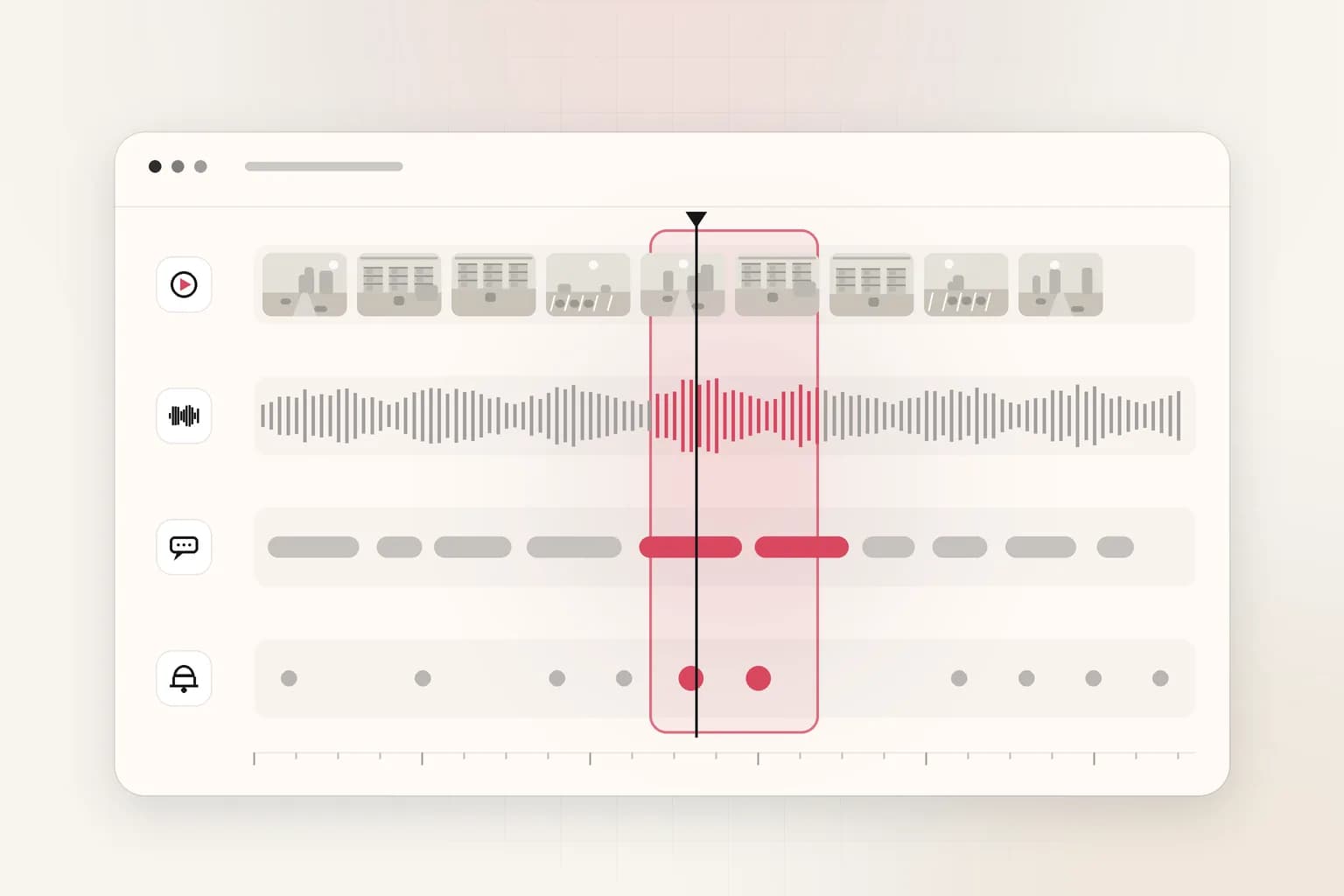
A video intelligence API attacks that gap after video exists:
- Ingest — upload a file or register a URL your policy allows.
- Index — run computer vision, speech, and text recognition pipelines.
- Store — persist embeddings, transcripts, and metadata beside the asset.
- Query — send natural-language or structured searches; receive timecodes and snippets.
That loop is what people mean when they contrast AI video search with timeline-only review. Our overview of what video indexing is goes deeper on signals; here we focus on the API contract procurement and engineering must read.
What capabilities should buyers expect?
Not every vendor uses the word “intelligence” the same way. Use this checklist against official documentation, not trade-show demos.
| Capability | Why it matters | Verify in docs |
|---|---|---|
| Multimodal index | Real incidents mix visual, audio, and OSD text | Separate models vs unified index |
| Natural-language search | Investigators phrase questions in plain words | Example queries, query limits |
| Analyze endpoints | Summaries, Q&A, or JSON events for automation | Rate limits, output schema |
| Deployment choice | Data residency and air-gapped sites | Regions, VPC, on-prem |
| Metering | Predictable COGS per hour reviewed | Per-minute, per-frame, per-query |
| Auth model | Service accounts and key rotation | OAuth vs API keys, audit logs |
Amazon Rekognition, discussed in our November 16 coverage of a Guardian investigation into large-scale face indexing, emphasizes face collections, label detection, and stored video analysis inside AWS accounts. That is a vision API, invaluable when your workflow is “match this face”, but it is not automatically “describe the shift handoff in room four.”
Google Cloud Video Intelligence API historically offered shot detection, explicit content filtering, text and object tracking, and speech transcription annotations. Google’s documentation now states the product is deprecated from September 14, 2026, with shutdown September 14, 2027, and recommends migrating to Gemini models. If your RFP still references Video Intelligence API, treat migration planning as a first-class line item.
Ceptory documents a unified video intelligence API at /en/video-intelligence-api: indexes, search, and analyze on recorded video via REST, with no SDKs and no camera bundles. Capabilities map to feature pages for search, analyze, and understand.

How does pricing differ between hyperscalers and Ceptory?
Buyers should model three meters: ingestion/indexing, storage/infra, and queries.
Ceptory (pricing page) charges:
- $0.042 per minute indexed
- $0.0015 per minute infrastructure
- $4 per 1,000 search queries
- First 10 minutes indexed free (
FREE_INCLUDED_INDEXED_MINUTES)
There are no published accuracy percentages, no customer counts, and no certifications to cite—only the metering the product enforces.
Hyperscaler vision APIs often bill per minute analyzed, per image, or per thousand inferences, with free tiers that do not match multi-terabyte security archives. Always fetch current pricing pages before board approvals; cloud list prices change quarterly.
Use internal tools before you buy:
| Planning task | Free tool on Ceptory |
|---|---|
| How many days of video? | CCTV storage calculator paired with retention guide |
| Will the network carry exports? | CCTV bandwidth calculator; see also how much bandwidth CCTV needs |
| What will manual review cost while you pilot? | Video review cost calculator |
A pilot that indexes 100 hours but forgets query volume usually surprises finance. Model both meters.
What is the difference between a video intelligence API and a VMS?
A VMS is the system of record for live cameras, roles, and retention schedules. A video intelligence API is a downstream analysis layer on copies or exports.
| Layer | Owns | Typical API role |
|---|---|---|
| Cameras and encoders | Real-time stream | None; Ceptory does not sell cameras |
| VMS / NVR | Recording, playback, user ACLs | Export MP4 or RTSP archive |
| Video intelligence API | Index + search + analysis | Ingest exports; return moments |
| Case management | Chain of custody | Attach API results as exhibits |
Our comparison of video intelligence platforms versus traditional VMS stays valid in 2026: do not rip out working recorders to test search. Export a representative incident set, index it, and measure time-to-answer.
Teams that already run natural-language enterprise video search in the dashboard use the same indices through the API for ticketing bots or SOAR playbooks—provided legal approves cloud processing of those exports.
Shortlisting vendors? See video intelligence API alternatives to Google, AWS, Azure and Twelve Labs for a priced side-by-side.
When should teams choose Ceptory versus building on a hyperscaler?
Choose hyperscaler vision APIs when:
- You already standardized on one cloud account and need face collections, content moderation, or label detection inside that boundary.
- Your data scientists will orchestrate multiple models themselves and want raw inference JSON.
Choose a purpose-built video intelligence API such as Ceptory when:
- Investigators ask multimodal questions daily and you want search + analyze without building vector pipelines.
- You need predictable per-minute indexing for heterogeneous exports (CCTV, drone, body-worn) rather than per-camera encoder hooks.
- Private cloud or on-prem is on the roadmap; enterprise deployments are priced separately from the public metered API.
Ceptory is not a counter-drone sensor, not a face registry, and not a replacement for legal advice on biometrics. It indexes footage you lawfully submit so reviewers spend fewer hours in finding moments in hours of CCTV.
Developers comparing integration effort should read our older multimodal retrieval API walkthrough for workflow patterns, then validate against current API docs—that post predates today’s summary and FAQ standards but still diagrams pipeline thinking.
How do you evaluate a video intelligence API in 30 days?
- Pick two real cases — one security (multi-camera), one operations or drone clip with speech.
- Document lawful basis — retention, PII, and union rules before upload.
- Export from the VMS — consistent codec and time sync; note timecode calculator offsets if audio drifts.
- Index a fixed minute budget — track indexing cost against the 10 free minutes, then paid minutes.
- Write ten search questions investigators already use; score precision manually.
- Test analyze calls — summaries for incident reports via the AI video report prompt builder.
- Compare to baseline — run the video review cost calculator for the same clips without API help.
Document false positives (wrong moment) and false negatives (missed moment). Vendors without transparent limits on clip length, concurrency, or query rate belong in the risk column, not the shortlist.
What changes for buyers in late 2026?
Google’s deprecation timeline for Video Intelligence API pushes teams toward Gemini-family video understanding, but enterprise RFPs still cite the legacy name. Update vendor questions to ask which model family backs search, not only which REST hostname.
Meanwhile face-recognition cloud programs face public scrutiny, as in the November 16, 2026 Guardian report on Rekognition-scale photo uploads we covered in our analysis. Even if your program is domestic corporate security, procurement now expects data-flow diagrams showing where embeddings live.
If “video intelligence api” is your search term, the honest conclusion is simple: you are buying time back for reviewers—measured in minutes indexed and queries answered, not in logo counts on a model card.
Ready to test on footage you already have? Start at Ceptory with the included free indexing minutes, link your case exports, and only scale when search beats scrubbing on your incident types.
How do security and drone teams phrase API requirements?
Procurement templates often hide the real question inside integration jargon. When SLTT agencies, utilities, or broadcast archivists ask for a video intelligence API, translate their bullets into testable behaviors:
- "Support H.264/H.265 MP4 exports" — confirm codec list and max file size in vendor docs, then test with a night-vision clip and a noisy drone clip.
- "Facial recognition optional" — decide whether you need gallery search (Rekognition-style) or description search (Ceptory-style); mixing both without policy creates audit risk.
- "SOC 2 / HIPAA" — ask for current attestations; do not accept marketing badges without scope dates.
- "Air-gapped preview" — ask whether on-prem is productized or a services SOW; Ceptory lists enterprise private cloud and on-prem as separate quotes.
For drone programs, requirement sets should reference drone monitoring use cases only when post-flight review is the bottleneck. Live BVLOS feeds still belong in VMS or vendor flight apps first.
What mistakes sink video intelligence API rollouts?
Scope creep is the usual killer: teams buy search, then expect real-time weapon detection on thirty streams without GPU budgets. Legal mismatch is second: exporting audio from two-party consent states without counsel clears transcription features but blocks release. Index once, search never is third: if investigators lack training and SOPs, the API becomes shelfware next to the incident report template.
Vendor lock-in through proprietary containers is fourth. Prefer APIs that return timecodes and transcripts you can re-index elsewhere. Ceptory’s model meters minutes and queries on files you own; you are not trapped in a camera OEM vault.
Finally, deprecation shock—see Google’s Video Intelligence API timeline—shows why architecture reviews must ask which model family backs search, not only which REST path was in last year’s RFP.
Who should own the API integration?
Assign three owners: IT security (keys, VPC, logging), legal (retention, biometrics, union agreements), and operations (query playbooks). Engineering can wire webhooks into ServiceNow or case tools, but operations must define what a good result looks like before automation fires.
Monthly, review query logs like ALPR audits: who searched, which case numbers, which cameras. Pair that discipline with how to write an incident report from video so API outputs land in consistent exhibits.
When Search Console shows impressions for "video intelligence api" but no clicks, the fix is usually answer-first copy on the product page plus honest buyer guides like this one—not keyword stuffing in footers.
Frequently asked questions
What is a video intelligence API in plain language?
It is a cloud or private service you call over HTTPS to upload or register video, wait while the platform indexes visual scenes, speech and on-screen text, then query that index for moments or structured analysis. It is not a video player and not a camera license.
How is a video intelligence API different from a VMS?
A VMS records live streams, manages cameras and replays by timecode. A video intelligence API works on recorded files or exports, adding semantic search and analysis. Most enterprises keep the VMS and add an API for investigations and compliance review.
What does Google Cloud Video Intelligence API do?
Google documents object, person, text, explicit-content and shot detection on stored or live video. Google’s docs state Video Intelligence API is deprecated from September 14, 2026, with shutdown September 14, 2027, and recommend migrating to Gemini models.
Does a video intelligence API include face recognition?
Some hyperscaler vision APIs emphasize face comparison collections. Enterprise video intelligence APIs such as Ceptory focus on multimodal search—scenes, speech and text—rather than enrolling national face galleries. Check each vendor’s privacy documentation before sending biometrics.
How does Ceptory price video intelligence API usage?
Ceptory charges $0.042 per minute indexed plus $0.0015 per minute infrastructure, search at $4 per 1,000 queries, with 10 minutes indexed free. Enterprise private cloud or on-prem deployments are priced separately.
Does Ceptory ship client SDKs?
No. Ceptory exposes a REST API at https://www.ceptory.com/api/v1 with Bearer keys from the dashboard. Integrators use standard HTTP clients; there are no published SDK packages to maintain.
Ceptory
Search your own footage in plain language. The free tier indexes 60 minutes of video.
Related reading
Keep reading
Industry News · 8 min read
Qwen4-Max Video API: Limits, Pricing, and What Teams Need
Read article
Video Intelligence · 8 min read
Video Intelligence API: Building Multimodal Retrieval and Analysis Workflows
Read article
Video Intelligence · 8 min read