Video Intelligence
IDF 3.5M Photos on Amazon Rekognition: Nov 16 Report
The Guardian reported Nov 16, 2026 that 3.5 million photos went to AWS Rekognition. Here is what was claimed, what Amazon said, and what video teams learn.

TL;DR
On November 16, 2026, the Guardian reported Israel's military uploaded 3.5 million Palestinian photos to AWS for Rekognition in early 2024. AWS and the IDF declined operational detail; buyers should separate face indexes from searchable video archives.
On Monday, 16 November 2026, The Guardian published an investigation alleging that Israel's military uploaded 3.5 million photographs of Palestinians into Amazon Web Services (AWS) so it could analyze them with Amazon Rekognition, the company's cloud image and video analysis service. The story lands in the same week as renewed scrutiny of AI in armed conflict and of how commercial vision APIs scale beyond consumer photo apps. For enterprise video intelligence buyers, the useful lesson is not geopolitics alone: it is what happens when mass identity libraries meet checkpoint cameras, drone frames, and cloud face indexes—and how that model differs from searching recorded video in natural language.
What did the November 16, 2026 investigation claim?
The Guardian's report, by Harry Davies and Yuval Abraham, cites leaked documents and interviews with military sources. Its central claim is that in early 2024, during the first months of Israel's ground offensive in Gaza, a military department commonly known as Rolling Stone informed Amazon of a decision to upload a large image catalogue so it could run a facial recognition project on Rekognition.
According to the Guardian, the images were moved into an AWS datacenter near Tel Aviv. The department name mirrors a long-running military system described in the piece as a central repository of information about Palestinians in Gaza and the West Bank. Sources told the Guardian the department had been exploring facial recognition on catalogues it already held, including identity-card photographs collected because Israel controls population registries in those territories.
The investigation also describes checkpoint photography after the October 2023 ground invasion: cameras captured people approaching temporary sites, and sources said facial recognition was used to match individuals against Rolling Stone holdings. A military source familiar with checkpoint work told the Guardian that Amazon's cloud infrastructure was chosen because of the "very large scale" of images collected at those sites. The Guardian states it is not clear whether all 3.5 million images uploaded to Rekognition came from those checkpoints.
Broader context in the same article includes Project Nimbus, the multivendor Israeli government cloud contract with AWS and Google that the Guardian has reported contains terms limiting the vendors' ability to unilaterally restrict government and military use. The piece also describes a segregated "walled garden" area within AWS's Israeli cloud for sensitive military data. None of those contractual details, by themselves, confirm operational use of Rekognition on the alleged photo set.
The Jerusalem Post, summarizing the Guardian investigation on November 16, 2026, repeats the 3.5 million figure, the Rolling Stone department name, and the early 2024 Rekognition notification timeline. It adds that The New York Times had previously reported experiments with commercial facial recognition in Gaza, including attempts to identify people in crowds and drone footage, with misidentifications of civilians described in that earlier coverage. The Jerusalem Post does not independently verify the new leaked files.
What did Amazon Web Services and the IDF say publicly?
The Guardian quotes an AWS spokesperson this way:
"We have no visibility into workloads held by our customers in its cloud. We respect the privacy of our customers, and we do not discuss our relationship without their consent."
On the separate claim that Israeli soldiers worked from AWS offices in Tel Aviv while exploring facial recognition in Gaza, the spokesperson said customers "regularly visit our offices for briefings and meetings" and that portraying those visits as anything else is "wrong and unsubstantiated."
The Israel Defense Forces told the Guardian it "does not intend to comment on engagements or services related to operational needs." The Jerusalem Post reports the same policy when asked about operational contracts.
For enterprise readers, that response pattern is familiar: cloud providers assert tenant isolation and no access to customer payloads, while government customers decline to discuss classified or operational procurements. Investigations therefore rely on document leaks, witness testimony, and parallel reporting—not on a joint press release with model accuracy metrics.
How does Amazon Rekognition work for faces and video?
To understand why 3.5 million still photos matter for video intelligence, read what Amazon documents about its own product. AWS's Rekognition developer guide describes Rekognition as a cloud image and video analysis service that can detect, analyze, and compare faces for use cases listed by Amazon, including user verification, cataloging, people counting, and public safety.
For facial search, Amazon's documentation explains that customers index faces into a face collection they own, then search stored video, streaming video, or images for faces that match entries in that collection. That architecture is gallery-first: you build or import a reference set, then ask the API "where does this face appear?" rather than "what happened in hour fourteen?"
Rekognition also supports label detection, text in video, person pathing, content moderation, and PPE detection on video. Those capabilities overlap partially with enterprise video intelligence products, but the pricing model, integration pattern, and buyer questions differ. Rekognition is one AWS SKU among many; most security teams still store evidentiary video in a VMS or evidence vault and only send clips or frames to cloud APIs under policy.
| Question type | Typical Rekognition workflow | Typical enterprise video intelligence workflow |
|---|---|---|
| Identity | Index known faces; search new media for matches | Search by description, speech, or on-screen text without a pre-built face gallery |
| Input scale | Millions of stills in S3; face collection growth | Hours of multi-camera MP4 or exports from VMS |
| Output | Match confidence, timestamps, bounding boxes | Ranked moments with transcripts and scene summaries |
| Governance | AWS account controls, collection retention | Export, redaction, and legal hold on copies you own |
If your team only needs "find every appearance of suspect X" and you may lawfully maintain a face gallery, Rekognition-style APIs can fit. If your team more often asks "who mentioned the valve leak?" or "when did the forklift enter frame three?", you are closer to multimodal video search than to CompareFaces.
How does this report connect to checkpoint and drone video?
The Guardian investigation is about still-image catalogues and cloud migration, but it repeatedly ties those catalogs to surveillance moments on video:
- Checkpoint cameras trained on people approaching control points.
- Earlier New York Times reporting, cited by both the Guardian and the Jerusalem Post, describing face detection in crowds and in drone footage during Gaza operations, with false positives noted in that prior coverage.
That distinction matters for drone program managers and public safety video leads. Drone video is often wide-area, low frame rate on subjects, and metadata-rich (GPS, gimbal angle). Face matching on drone clips is technically possible with Rekognition's stored video analysis, but resolution and angle limits hit faster than on checkpoint close-ups. Teams that conflate "we bought a vision API" with "we can search every flight tape" usually discover the gap during the first after-action review.
Our guide on how to review drone inspection footage faster focuses on operational search on recorded flights—defects, structures, and environmental cues—not on biometric identity. The Guardian story is a reminder to keep those workflows and legal bases separate in your architecture diagram.
What is the difference between face matching and searchable video archives?
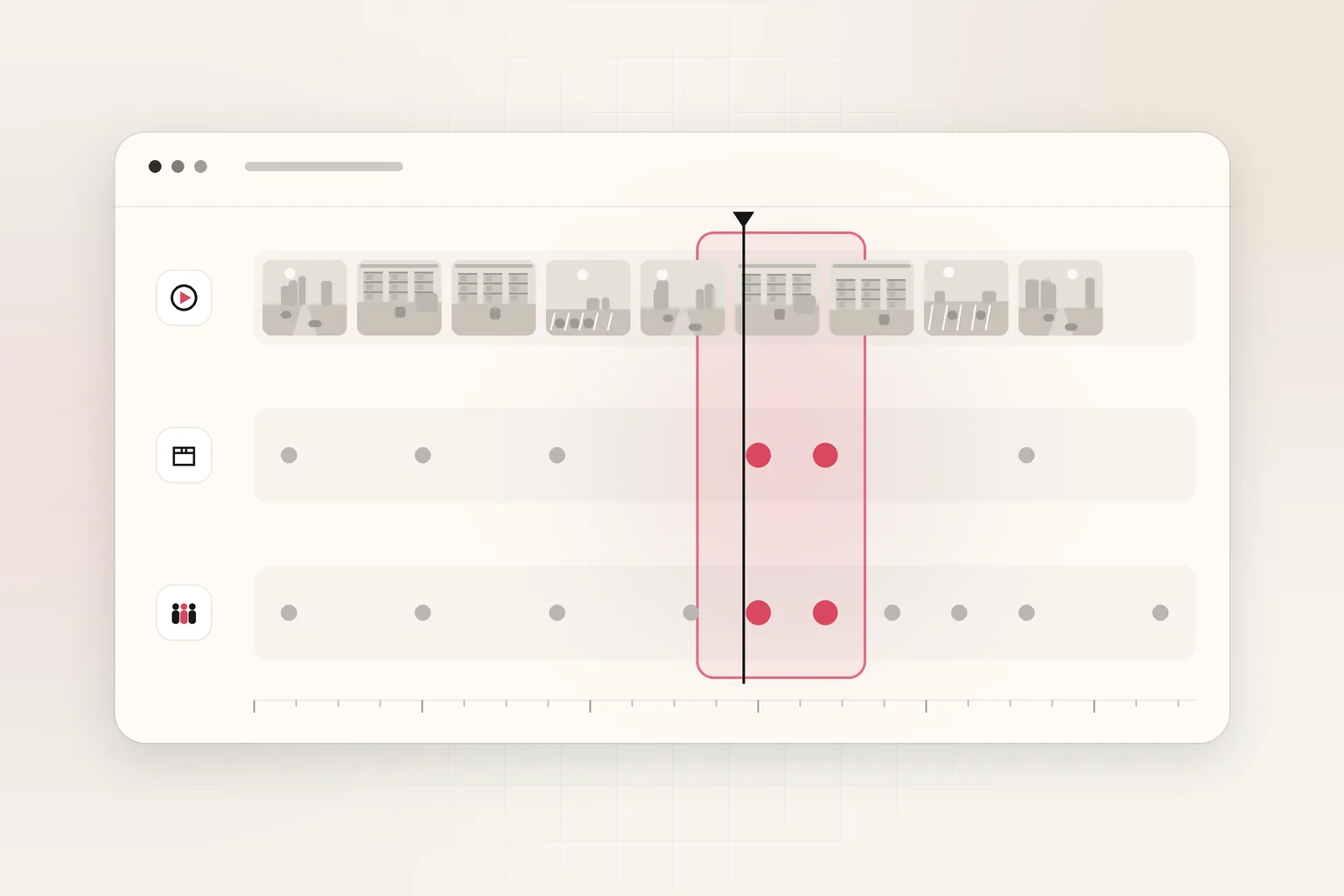
Video indexing turns recorded footage into searchable signals: scenes, motion, speech, on-screen text, and timing metadata. The goal is incident reconstruction and compliance review when you do not already know which face or plate to match.
Face recognition APIs invert part of the problem: they optimize repeat identification against a known set. At scale—millions of enrolled stills—that becomes a data platform project: S3 storage classes, collection sharding, access logging, and legal review of biometric processing.
Ceptory sits on the indexing and search side of that map. Ceptory indexes recorded video so teams can query natural language across uploaded or URL-linked files through the dashboard or REST API. It does not sell cameras, does not publish SDKs, and does not ship a government face gallery. Pricing on ceptory.com/pricing is $0.042 per minute indexed plus $0.0015 per minute infrastructure, search at $4 per 1,000 queries, with 10 minutes indexed free—metered on footage you lawfully submit, not on enrolling third-party identity databases.
Where Rekognition-style stacks fit public safety or border programs, Ceptory is the more honest fit when your bottleneck is analyst hours scrubbing NVR exports after an event—not maintaining a national photo registry.
Privacy teams reviewing exports that contain faces or license plates should plan redaction before wider sharing. Our network site BGBlur covers privacy tooling for faces and plates on camera when you need that step called out explicitly for released clips.
A related news breakdown on explainx.ai walks through the Guardian claims versus what AWS and the IDF confirmed in statements.
What should investigators and architects do now?
Whether you work in government, critical infrastructure, or corporate security, the November 16 reporting is a prompt to audit architecture, not to rip out every vision API.
- Inventory biometrics. List every service that stores face vectors or government IDs. Note region, retention, and who can query collections.
- Separate identity from incident search. Use face collections only where law and policy explicitly allow them. Route general investigations through multimodal search on redacted exports.
- Log queries. Require justification fields on face searches the way courts expect for ALPR lookups. Our post on the Sixth Circuit ALPR warrant ruling shows how US courts treat persistent location trails; biometric programs face parallel scrutiny in many jurisdictions.
- Model checkpoint video retention. Use the CCTV storage calculator and retention guide so checkpoint-adjacent cameras do not keep more days than counsel approves.
- Run a tabletop on false positives. If you deploy face match on drone or wide-angle video, rehearse misidentification response using incident report templates from video.
None of these steps depend on confirming every Guardian allegation. They follow from documented Rekognition capabilities and public non-denial responses from AWS and the IDF.
What changes for buyers after November 16?
No new Rekognition feature shipped because of the Guardian article. Pricing, model versions, and API quotas on AWS documentation did not change on that date. What changed is visibility: another large-scale example of cloud face indexing tied to wartime surveillance context, with operational uncertainty explicitly acknowledged in the reporting.
If your procurement team is comparing hyperscaler vision APIs with video intelligence platforms, use questions buyers actually type:
- What is Amazon Rekognition used for? Label and face analysis on S3-stored images and video, including face collection search.
- Does Rekognition answer natural-language questions about speech? Not as a single product promise; you combine other AWS services or third-party indexers.
- Where does Ceptory fit? Multimodal search and analysis on recorded footage you already own, priced per indexed minute and query, without requiring a prebuilt face corpus.
Teams ready to test search on a lawful sample export can start at Ceptory with the included free minutes, then scale only if query quality beats manual scrubbing on real cases.
Frequently asked questions
What did the Guardian report about Amazon Rekognition on November 16, 2026?
The Guardian said leaked documents and military sources described about 3.5 million photographs uploaded to an AWS datacenter near Tel Aviv in early 2024 so an IDF department called Rolling Stone could use Rekognition on a facial recognition project. The paper could not confirm whether the project became operational or where every image was captured.
What is Amazon Rekognition used for in video and image archives?
According to AWS documentation, Rekognition detects and compares faces in stored or streaming video, indexes faces into a customer-owned face collection, and can search video for matching faces. It is a cloud API focused on computer vision labels and face similarity, not natural-language questions across speech and scenes.
Did Amazon confirm the Israeli military upload?
No. An AWS spokesperson told the Guardian the company has no visibility into customer workloads, respects customer privacy, and does not discuss relationships without consent. The Jerusalem Post relayed the same statement on November 16, 2026.
Did the IDF confirm using Rekognition on 3.5 million photos?
The IDF told the Guardian it does not intend to comment on engagements or services related to operational needs. The Jerusalem Post reported the same non-comment policy when asked about contracts tied to operational needs.
How is Rekognition different from enterprise video intelligence search?
Rekognition matches faces and vision labels against indexed collections or analyses frames you send. Enterprise video intelligence platforms index longer footage for multimodal search—scenes, speech and on-screen text—in plain language. They do not require pre-enrolled face galleries for every investigation.
What should corporate security teams do after this report?
Document which cloud APIs process biometrics, set retention limits on face collections, and separate identity matching from incident search workflows. Export redacted clips where privacy rules apply, and use audit logs on who queried face indexes.
Ceptory
Search your own footage in plain language. The free tier indexes 60 minutes of video.
Related reading
Keep reading
Video Intelligence · 8 min read
Pegasus 1.5 in Snowflake Cortex: Video Analysis From SQL
Read article
Video Intelligence · 9 min read
StreamVibe: Proactive Video Agents and What They Mean for Footage
Read article
Video Intelligence · 8 min read