Guides
How Video Embeddings Work for Enterprise Search
How video embeddings turn footage into searchable vectors: indexing steps, query types, accuracy caveats, and when to use a platform vs an API.

TL;DR
Video embeddings map short clips and text queries into the same vector space so nearest-neighbor search returns timestamps, not filenames. This guide explains the pipeline, costs, and limits for security, drone, and archive teams.
How do video embeddings work for teams that must find people, vehicles, defects, or spoken cues inside large libraries? In practice, a video embedding is a numeric fingerprint of a short clip. Search software places text, image, or audio queries in the same space, ranks the closest clips, and returns timestamps you can open in a review tool. This guide explains the pipeline security, drone, and archive buyers ask about, with worked steps, cost framing, and honest limits, so you can compare APIs like Twelve Labs Marengo embeddings with platforms such as Ceptory.
What is a video embedding?
A video embedding (often called a vector) is a list of floating-point numbers produced by a multimodal model. Clips that look or sound alike should end up near each other in that space; unrelated clips should sit farther apart.
Researchers popularized the idea for images and text with models such as CLIP, which maps captions and frames into one latent space. Enterprise products extend the same idea to audio, on-screen text, and long files by embedding scenes or rolling windows instead of single frames.
In what is video indexing, we described embeddings as the layer behind many natural-language search boxes. This post goes deeper on how they are built, what can go wrong, and where they fit next to transcripts and OCR.
How does embedding-based video search work end to end?
Most production flows share five stages. Names differ by vendor, but the jobs are the same.
| Stage | What happens | Typical output |
|---|---|---|
| Ingest | Register file ID, camera, time zone, retention class | Source URI plus metadata row |
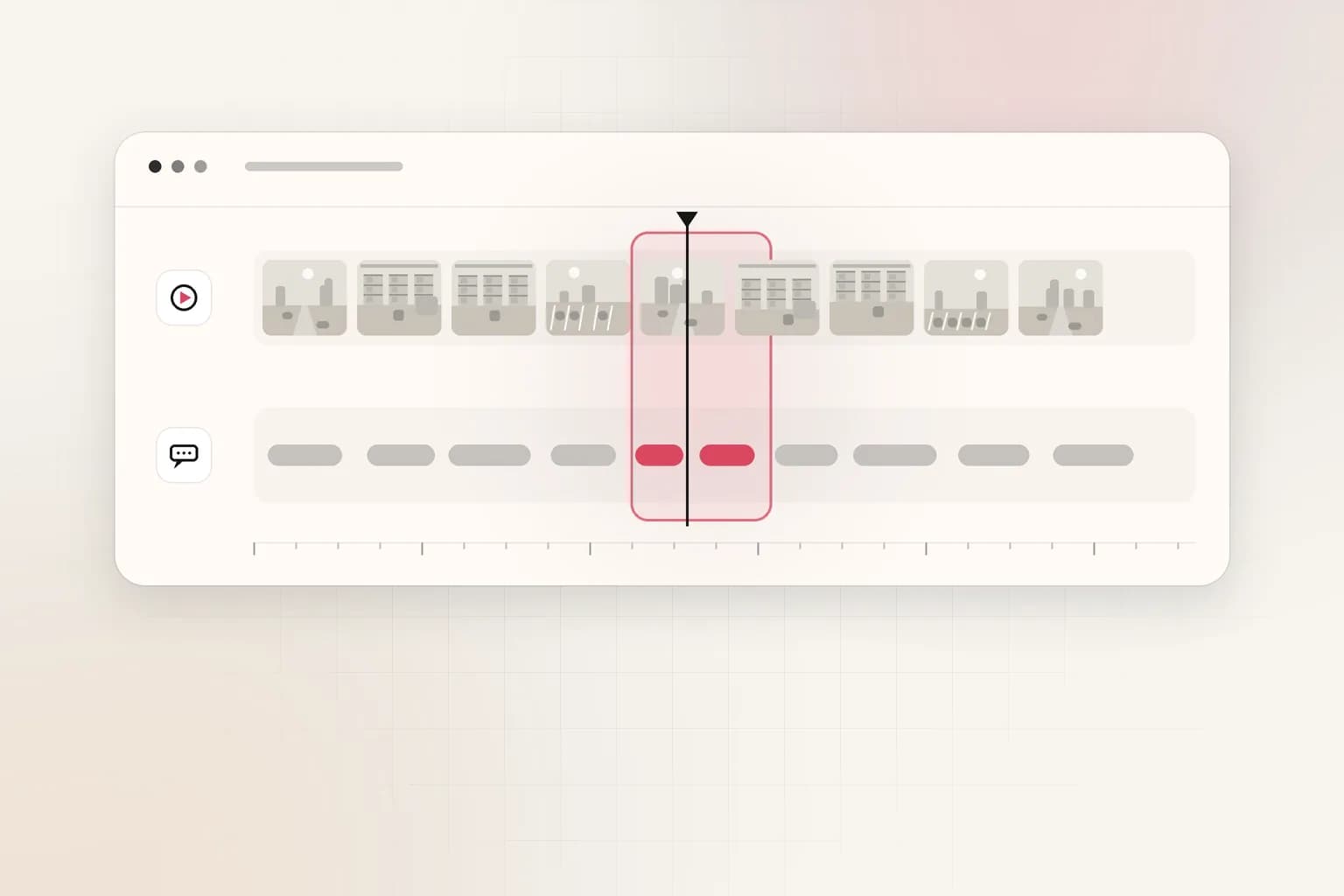
| Segment | Detect shots, scenes, or fixed windows | Start and end timecodes per span |
| Encode | Model reads pixels and audio for each span | Embedding vector plus optional labels |
| Index | Vectors stored in ANN or database index | Searchable index keyed by file and time |
| Query | User text, image, or exemplar clip embeds; nearest neighbors returned | Ranked hits with scores and timecodes |
The critical design choice is when you pay for encoding. Architectures like the Twelve Labs and Pixeltable CuratorAI pattern described on November 10, 2026 compute embeddings on insert, then answer browse and recommend requests from stored vectors. Interactive search still embeds the query at runtime.
What is the difference between frame embeddings and scene embeddings?
Frame embeddings sample stills every N seconds. They are cheap and easy but can miss actions that happen between samples.
Scene embeddings follow detected cuts or semantic boundaries. Twelve Labs cites interviews that jump topics mid-file; scene vectors let a query match one segment while the UI still opens the parent video. Drone and CCTV workflows benefit the same way when a single file mixes taxi, inspection pass, and landing.
Our post on multimodal video analysis for operational review shows why teams often keep parallel indexes for speech and OCR instead of relying on visuals alone.
How do multimodal queries hit the same index?
Providers such as Twelve Labs document one shared space for video, audio, text, and images. Pixeltable's Twelve Labs tutorial demonstrates cross-modal search: the same table index answers a text question, an image still, or another video clip.
Conceptually:
Text query  --->  Embed model  --->  query vector  ---\
                                                       similar?  ---> ranked timestamps
Video clip  --->  Embed model  --->  clip vector   ---/
That is why a text query like worker near loading dock can surface a clip whose folder name is only CAM04_20261101.mp4, provided the model recognized people and context during encoding.
Ceptory's product layer exposes natural language search across scenes, speech, and on-screen text without requiring you to run Marengo, Pixeltable, or your own vector database. Under the hood, similar retrieval ideas apply; the difference is who operates the pipeline.
What numbers should planners use?
Use ranges for capacity math, not as vendor SLAs.
| Assumption | Conservative planning value | Why it matters |
|---|---|---|
| Scene length | 8 to 30 seconds | More scenes mean more vectors and more embed API calls |
| Vectors per hour of source | 120 to 450 | Depends on scene detector aggressiveness |
| Query embed latency | 50 to 300 ms | Adds to search response time besides index lookup |
| Re-embed on model upgrade | Full catalog | Model changes usually require recomputing vectors |
Worked example: A site indexes 500 hours of retained CCTV per month as 15-second windows (no scene detector). That is roughly 120,000 windows. If your stack charges per minute of source video rather than per vector, use minute math instead. On Ceptory's published prepaid rates, 500 hours is 30,000 minutes, so indexing alone is about 30,000 × $0.0435 ≈ $1,305 before search queries, using the combined $0.042 indexing plus $0.0015 infrastructure rate from billing.
Cross-check storage separately with the CCTV storage calculator; embeddings add a derived index cost on top of raw retention.
How do embeddings compare with transcripts and OCR?
Embeddings shine at fuzzy similarity: clothing color, weather, crowd density, machine state. They struggle when the question needs exact tokens: a plate number, a serial on a name badge, or a quoted regulation section.
| Signal type | Best for | Weak when |
|---|---|---|
| Video embedding | Appearance, action, setting, rough object class | Exact strings, small text, rare logos |
| Speech-to-text index | Spoken commands, radio calls, interviews | No audio, heavy accent without good ASR |
| On-screen text OCR | Overlaid titles, POS totals, safety signage | Glare, motion blur, tiny fonts |
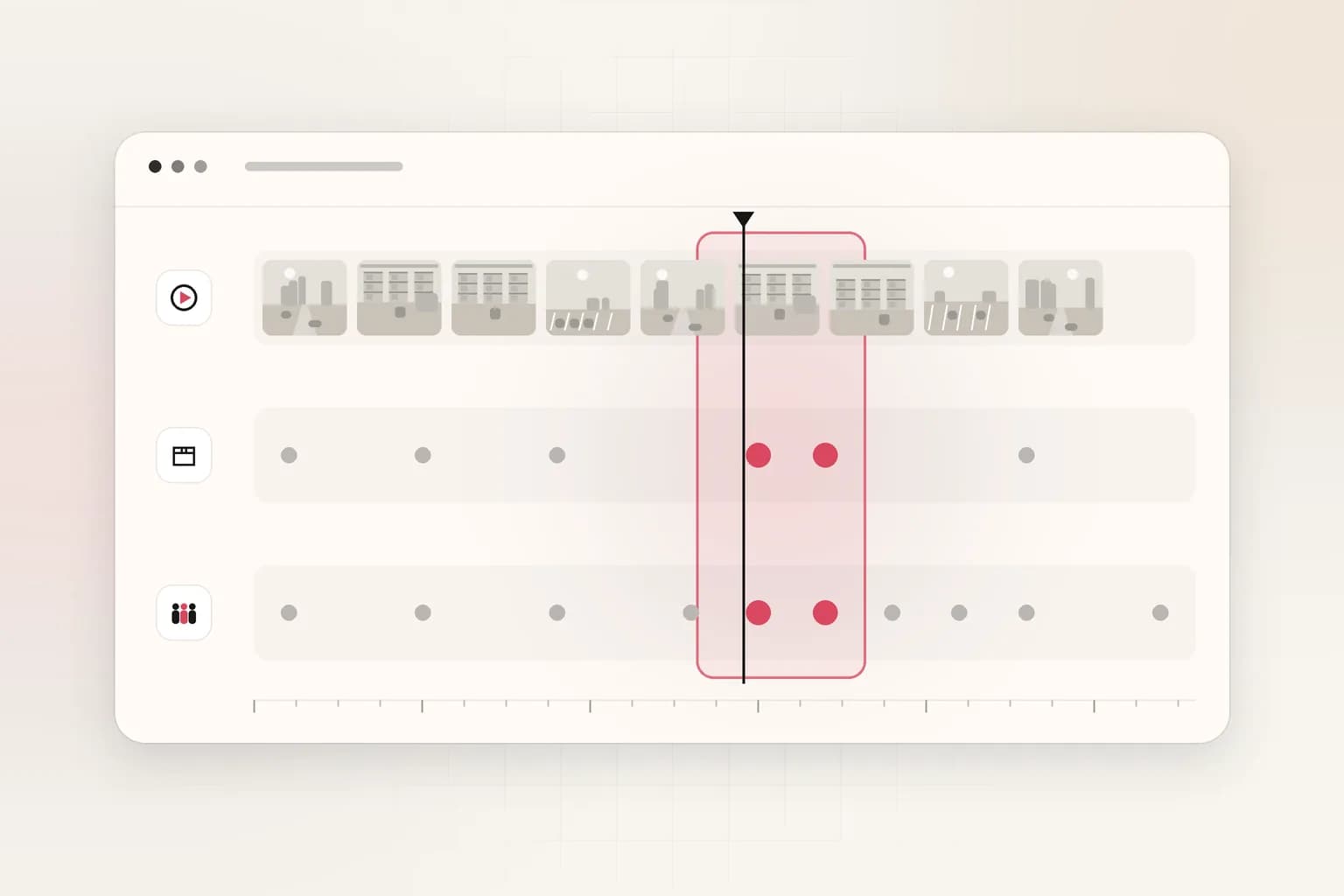
Strong operations stacks store all three and let the UI merge ranks. The video intelligence API post walks through that retrieval pattern for builders.
What are common failure modes?
Buyers should test for these before promising leadership instant search.
When do embeddings hallucinate relevance?
Vectors encode statistical similarity, not courtroom certainty. Two clips can score highly because they share lighting and aisle layout, not because the same person appeared. Always open the hit and note false positives in your SOP.
When does domain shift break search?
Models trained heavily on consumer internet video may underperform on infrared, fisheye dewarp, or monochrome security feeds. Pilot on your worst cameras, not your showroom demo.
When do you need hybrid filters?
Regulated teams often require camera ID, time window, and access class filters before vector ranking. Pure semantic search across an entire city NVR without metadata filters returns unusable hit lists.
If your workflow starts from an alarm, pair embedding search with the steps in how to write an incident report from video and the incident report template.
How does this relate to the Twelve Labs and Pixeltable launch?
On November 10, 2026, Twelve Labs described CuratorAI, where Marengo 3.5 scene vectors and Pegasus 1.5 attributes land in Pixeltable on insert, then power For You rows without another API call per page view. Read our breakdown in Twelve Labs and Pixeltable long-form discovery.
That architecture is the build-it-yourself pattern: you own ranking rules, scene splitters, and frontend code. Ceptory targets teams that want search and analyze on recorded video now via dashboard and REST API, with per-minute prepaid indexing instead of assembling databases and embed queues.
Compare neutral facts on Ceptory vs Twelve Labs before you commit engineering quarters to a custom catalog.
What should teams do before buying embedding search?
Use this sequence in a two-week pilot:
- Pick 20 representative hours — include night IR, rain, and busy lobby scenes.
- Write 30 real queries your investigators already use (people, vehicles, spoken phrases, signage).
- Define success — for example, correct moment in top five hits for 70 percent of queries.
- Log false positives — note whether failure was lighting, motion blur, or missing speech OCR.
- Measure wall time — compare pilot search against manual scrubbing using the video review cost calculator.
- Decide build vs buy — if you only need search on exports, a platform index is usually faster than standing up Pixeltable, Marengo, and a custom app.
Where does Ceptory fit?
Ceptory indexes recorded video you upload or register by URL, then supports natural language search and analysis across scenes, speech, and on-screen text. It is not a vector-database SDK; there are no published SDKs, only the documented REST API. Pricing is prepaid per indexed minute plus per-query search as listed on /pricing.
Embeddings are one part of that stack. You still bring retention policy, chain of custody, and access control. Ceptory does not sell cameras and does not quote accuracy percentages or certifications.
If you are standardizing how investigators move from query to clip export, start on the Ceptory home page and run the free 10-minute indexing allowance on a single difficult shift recording before you scale.
How should legal and security reviewers treat embedding hits?
Treat a high similarity score as a lead, not a conclusion. Investigators should log which model version produced the vector, which time span was embedded, and who exported the clip for downstream cases. When footage may be disclosed, run your normal redaction workflow before sharing outside the security team; face and plate privacy tools remain separate from embedding search.
For retention, embeddings usually expire with the parent video policy. If you delete source files on schedule but keep vectors longer, you can recreate identifications without the underlying evidence. Align embed index TTL with your records schedule the same way you align NVR retention, and note the choice in your incident SOP.
Related reading: Enterprise video search in natural language for investigator workflows, and video intelligence platforms vs traditional VMS for where search sits relative to your NVR.
Frequently asked questions
What is a video embedding in plain language?
A video embedding is a fixed-length list of numbers that represents what a clip looks and sounds like. Similar clips sit close together in that number space, so software can rank footage by meaning instead of by filename or tag.
Do embeddings replace storing the original video file?
No. Embeddings are a derived index layer stored beside metadata and transcripts. The master recording stays the evidence file; embeddings power fast similarity search over it.
What clip length should you embed for investigations?
Many systems embed scenes or fixed windows from a few seconds to about 30 seconds. Shorter windows localize a moment; longer windows capture context but blur fine detail.
Can text search and image search use the same video index?
With multimodal models such as Marengo-style embedders, text, image, audio, and video queries can share one index, which is what Pixeltable documents for Twelve Labs integrations.
How much does embedding-heavy indexing cost on Ceptory?
Ceptory charges prepaid indexing at $0.042 per minute plus $0.0015 per minute infrastructure, with search at $4 per 1,000 queries. The first 10 indexed minutes are free on the developer workspace.
When are embeddings not enough on their own?
Embeddings excel at similarity but can miss rare attributes, exact license plates, or quoted speech unless the pipeline also runs OCR, ASR, or structured detectors and stores those fields for hybrid search.
Ceptory
Search your own footage in plain language. The free tier indexes 60 minutes of video.