Industry News
Nemotron 3.5 Super VL on SageMaker: Video Inference
AWS added NVIDIA Nemotron 3.5 Super VL to SageMaker JumpStart on Nov 9, 2026. Here is how video inference works, limits, and what teams should test first.
TL;DR
On November 9, 2026, AWS put NVIDIA Nemotron 3.5 Super VL in SageMaker JumpStart with NVFP4 and BF16 variants. The 120B vision-language model accepts short MP4 clips plus text and returns answers you can wire into review workflows—within tight payload and context limits.
On November 9, 2026, Amazon Web Services said NVIDIA Nemotron 3.5 Super VL is available in Amazon SageMaker JumpStart. The post positions Super VL as the vision-language model in the Nemotron 3.5 family: a 120-billion-parameter hybrid mixture-of-experts backbone with 12 billion active parameters per token, a C-RADIO vision encoder, and inputs that include images, video, and text. For teams that already search security, operations, or inspection footage, the headline is practical—AWS now documents a hosted path to video question answering on enterprise GPUs, with NVFP4 weights tuned for latency and a BF16 reference checkpoint for customization.
That is not the same problem as indexing an entire NVR. JumpStart serves one clip per request, inline, through a vLLM chat API. Still, the release matters because it standardizes how builders experiment with short-clip understanding before they decide whether to build search, summaries, or agent tools on top.
What did AWS ship on November 9?
The AWS Machine Learning Blog post lists two JumpStart variants:
| Variant | Checkpoint size (approx.) | Default instance | Typical use |
|---|---|---|---|
| NVFP4 | About 75 GB | ml.g7.24xlarge (4x RTX PRO 4500 Blackwell Server Edition) | Optimized inference on G7 |
| BF16 | About 249 GB | ml.p5en.48xlarge (8x H200) | Full-precision reference for SFT, RL, or custom quantization |
Both accept image, video, and text inputs and return text. AWS reports context lengths up to 1 million tokens in model documentation, but JumpStart serving configurations in the post use much smaller deployed windows—2,275 tokens on generate profiles, up to 15,600 tokens on modify profiles.
NVIDIA describes training that includes multimodal supervised fine-tuning on vision, reasoning, tools, chat, safety, and long-context data, followed by reinforcement learning and distillation. The NVFP4 checkpoint uses quantization-aware distillation from BF16 while keeping vision encoder, connector, Mamba convolutions, and embeddings in BF16.
How does video inference work on JumpStart?
AWS walks through a base64-encoded MP4 example: you embed the clip as a video_url data URL, pair it with a text question, and call the endpoint’s chat-completions API. NVIDIA’s sampling guidance in the post sets temperature 0.6 and top_p 0.95 for image and video requests, with reasoning disabled when you want a direct caption or summary.
Important constraints from AWS best practices:
- Network isolation — the endpoint cannot fetch URLs; all media must be inline base64.
- One video per request on the JumpStart serving configuration AWS documents.
- Frame sampling is chosen at endpoint launch, not per call; per-request
media_io_kwargsare rejected. - Payload size — compress clips and stay within invocation limits; AWS does not publish a single megabyte cap in the post, but it repeatedly warns about encoded request size.
For reasoning-heavy video tasks, AWS suggests max_tokens of at least 8,192 when reasoning stays enabled, or disable reasoning for shorter answers.
Measured throughput in the post (generate profile: 250 input tokens, 1,500 output tokens, five concurrent streams) shows NVFP4 on ml.g7.24xlarge at about 63 output tokens per second per request and BF16 on ml.p5en.48xlarge at about 141 tokens per second, with time-to-first-token near half a second in those tests.
What do NVIDIA’s multimodal benchmarks show?
The AWS post highlights NVIDIA-reported scores where evaluation settings are held constant between BF16 and NVFP4. Video-relevant rows include Video-MME v2 at 32.85 (BF16) and 32.54 (NVFP4), plus document and GUI benchmarks such as MMLongBench-Doc and OSWorld-Verified.
Those numbers describe NVIDIA’s benchmark suite, not your parking-lot NVR. Video-MME-style tasks use curated clips with known questions. A security operations center still needs retention policy, chain of custody, and search across days of cameras—capabilities a one-shot endpoint does not provide.
For full methodology, AWS points readers to the NVIDIA Nemotron 3.5 Super VL technical report linked from the blog.
Where does Super VL fit next to archive search?
JumpStart Nemotron is closest to clip QA and agentic document plus video workflows AWS lists explicitly: OCR and charts, GUI grounding for computer-use agents, and multimodal agents with tool calling and JSON schema output.
That overlaps conceptually with posts on Gemini Robotics ER 2 moment finding and multimodal operational review, but the deployment shape differs. Google pitched robotics reasoning; AWS pitches self-hosted endpoints with enterprise IAM. Neither replaces a search index over historical footage.
Teams storing video in a VMS typically need:
- Ingest — continuous files from dozens of cameras or drones.
- Index — speech, on-screen text, and visual semantics across time.
- Retrieve — ranked moments from natural-language queries without re-encoding whole shifts as base64.
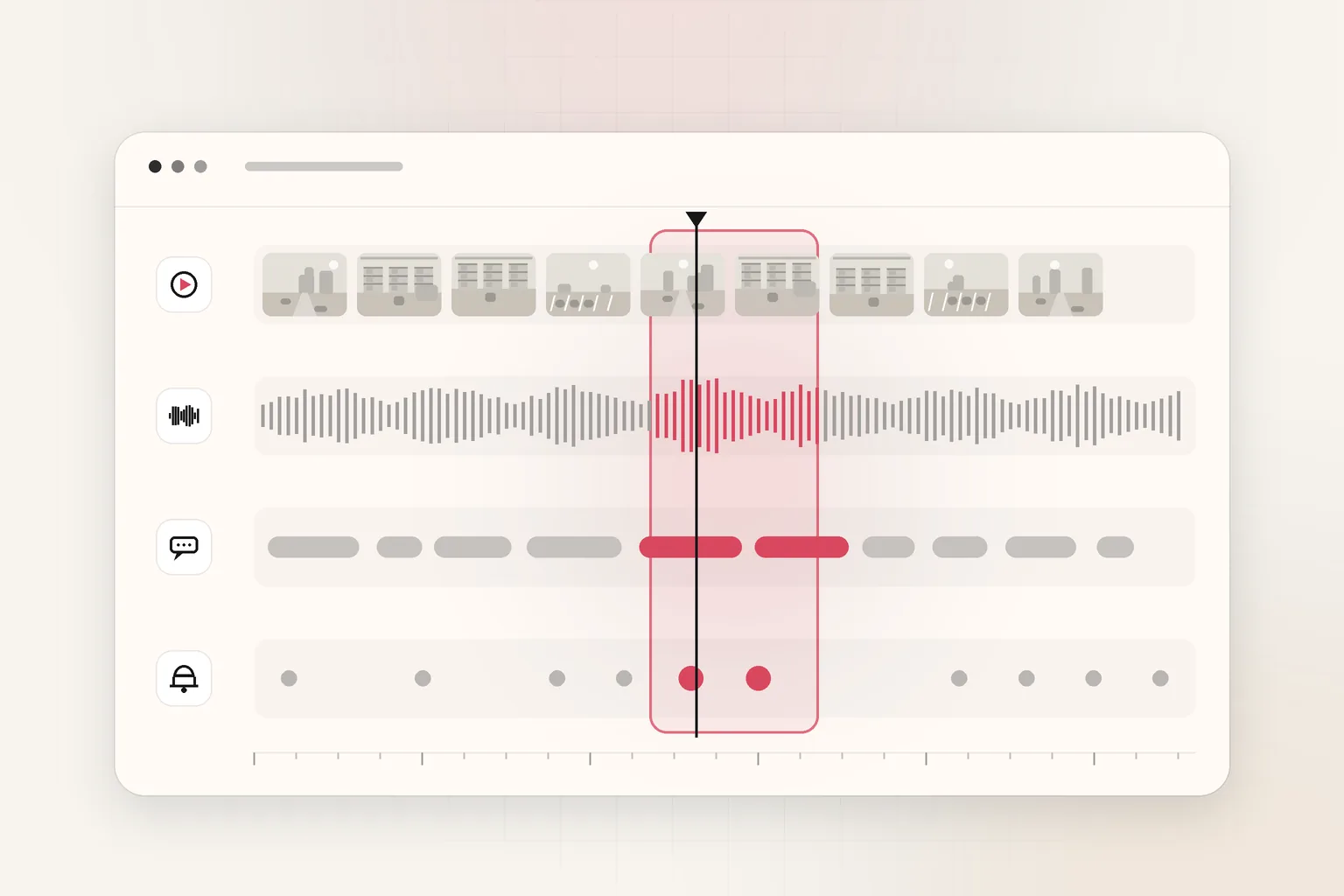
That workflow is what natural-language enterprise video search describes, and what the video intelligence API is built for—index once, query many times. Nemotron on JumpStart is better suited as an optional analysis step on clips you already isolated, not as the isolation mechanism itself.
What should security and ops teams test first?
If you already run SageMaker and have G7 or P5en quota, a sensible proof of concept stays narrow:
- Pick ten representative clips — one minute each, H.264 MP4, from CCTV, body-worn, or drone exports (not live RTSP).
- Deploy NVFP4 with a modify inference config so prompts with vision tokens fit the 15,600-token window AWS documents.
- Ask grounded questions — "Was a forklift in the loading lane?", "Did the speaker mention the gate code?", "What text appears on the delivery label?"
- Log latency and cost — note instance uptime; AWS says deployment takes about ten minutes on ml.g7.24xlarge but charges continue until you delete the endpoint.
- Compare to your search tool — run the same questions against indexed archives if you have them; note where clip QA succeeds but cross-camera search fails.
Document where the model hallucinates motion or misreads low-light plates. Those failure modes inform whether you need human review, higher bitrate exports, or dedicated search indexing instead of larger prompts.
How does Ceptory relate to Nemotron-style models?
Ceptory does not claim to run Nemotron or any single vendor foundation model. Product truth is simpler: you upload video or add it by URL through the API, Ceptory indexes it, and you search and analyze in natural language across scenes, speech, and on-screen text. Pricing on /pricing is $0.042 per minute indexed plus $0.0015 per minute infrastructure, $4 per 1,000 search queries, with 10 minutes free to start.
Where Nemotron on JumpStart fits honestly:
- Good fit — your ML team wants a custom agent that reads a clip and calls tools; Ceptory is not that agent runtime.
- Ceptory fit — investigators need find the shift where the pallet fell across a week of warehouse cameras without hand-picking clips first.
You can use both: Ceptory finds candidate moments; a JumpStart endpoint runs a deeper structured extraction on the exported segment—provided your governance allows sending that segment to AWS.
What should you do now?
- Read the AWS announcement and confirm instance quotas for ml.g7.24xlarge or ml.p5en.48xlarge in your account.
- Decide whether your use case is clip QA (JumpStart) or archive search (indexing platform); mixing them without a boundary usually wastes GPU hours.
- If archive search is the gap, pilot Ceptory search on a few exported investigation files before scaling endpoint costs.
- Delete SageMaker endpoints after tests; AWS includes cleanup code in the post because idle GPUs dominate surprise bills.
- Revisit video intelligence API workflows if you are composing retrieval plus analysis in one pipeline.
Related reading: Alibaba Qwen4-Max on Model Studio documents another November 2026 multimodal video API path with two-hour input limits and lower Singapore list prices.
Foundation models that accept video will keep shipping on cloud marketplaces. The procurement question for enterprise video teams stays the same: can you find the moment first, at scale, with audit-friendly storage? JumpStart Nemotron answers questions about clips you already hold; indexing answers which clips matter. Ceptory focuses on the second problem for recorded footage from any source.
What mistakes do teams make with JumpStart video endpoints?
The AWS post is explicit about footguns that show up in almost every first deployment. Treat this as a checklist for your security architecture review:
Oversized uploads. Encoding a full hour of 4K as base64 inside a JSON body will fail or stall long before the model runs. Export short segments around the timecode you already know, or let an indexing layer narrow the window first.
Wrong inference profile. A generate configuration with a 2,275-token model length cannot fit a multipage PDF rendered to images plus a video snippet. AWS tells you to pick modify profiles when running image, video, and reasoning together.
Forgetting quota. New accounts may have zero ml.g7 capacity. Procurement teams often approve software before cloud quotas exist, which pushes pilots into BF16 on P5en and multiplies cost overnight.
Treating captions as evidence. VLMs summarize what they believe they saw. For disciplinary or court-facing workflows, the playable file and chain of custody still beat a model paragraph unless your counsel signs off on machine summaries.
Leaving endpoints running. The cleanup snippet in the AWS post exists because an InService endpoint bills GPU hours continuously. Tag sandbox deployments and auto-teardown them Friday night.
How does Nemotron compare to building on Bedrock or self-hosted vLLM?
JumpStart is one managed path; it is not the only AWS entry for multimodal work. Some teams will compare it with Amazon Bedrock models or with self-hosted vLLM on EC2. JumpStart’s value is curated containers, prebuilt parallelism, and documented inference configs for this exact checkpoint. Self-hosting buys flexibility at the price of your team owning driver versions, CUDA mismatches, and autoscaling logic.
None of those choices solve corporate search across footage that already lives in five regional NVRs. They answer what is in this payload right now. Keep the problems separate in your RFP so you do not pay GPU rates to replace a missing index.
Frequently asked questions
When did Nemotron 3.5 Super VL arrive in SageMaker JumpStart?
The AWS Machine Learning Blog published the availability post on November 9, 2026. You can deploy NVFP4 or BF16 weights from SageMaker Studio, the SageMaker Python SDK, or the model page on Hugging Face linked from JumpStart.
Does Nemotron 3.5 Super VL accept video input?
Yes. AWS documents short MP4 clips as base64 data URLs in chat-completions payloads. Frame sampling is fixed when the endpoint launches; you cannot change it per request on the JumpStart serving configuration.
What instances does JumpStart recommend for Nemotron Super VL?
NVFP4 defaults to ml.g7.24xlarge on G7 Blackwell GPUs; BF16 uses ml.p5en.48xlarge with H200 GPUs. AWS notes ml.g7 quotas often start at zero in new accounts, so request a quota increase before deploying.
How large can a video request be on JumpStart?
AWS warns to keep encoded requests within endpoint payload limits and to use short, compressed clips. The post ties context to serving profiles—modify configurations allow up to 15,600 tokens including vision tokens from sampled frames.
Is JumpStart Nemotron a replacement for a video search archive?
No. It answers questions about clips you send inline. It does not index thousands of hours or return ranked moments across a VMS. Ceptory indexes recorded footage for natural-language search across scenes, speech and on-screen text.
What does Nemotron Super VL cost on AWS?
The announcement does not list endpoint pricing. Your bill combines SageMaker instance hours, storage and data transfer while the endpoint is InService. Check the AWS pricing pages for your chosen instance type before leaving a deployment running.
Ceptory
Search your own footage in plain language. The free tier indexes 60 minutes of video.
Related reading